
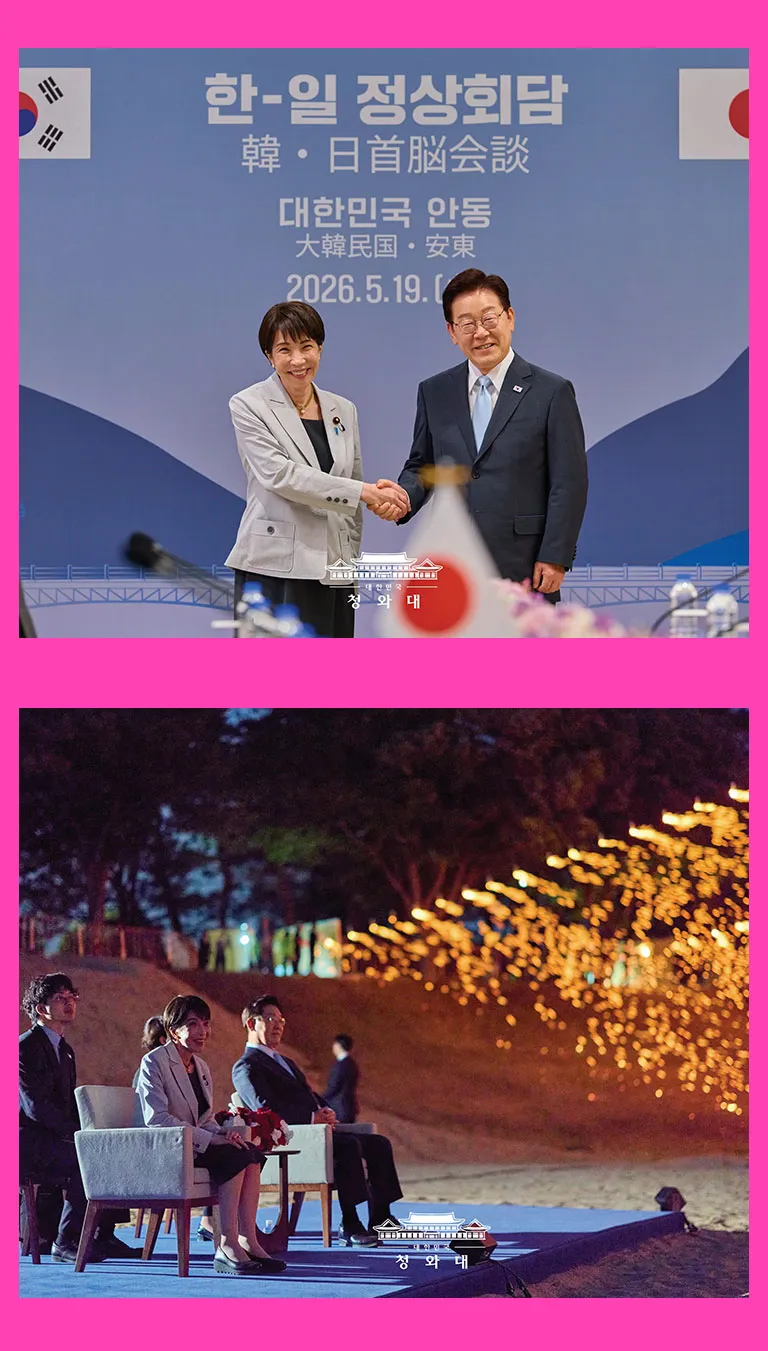
President Lee Jae Myung and Japanese Prime Minister Sanae Takaichi met on May 19 in Andong, Gyeongsangbuk-do Province. It marked the sixth Korea-Japan summit since the launch of the Lee Jae Myung administration and the second instance of shuttle diplomacy this year.
The two leaders shared assessments of major international issues—including the situation in the Middle East, energy security and supply chains—and discussed ways to strengthen bilateral cooperation. They agreed that peace and stability in the Middle East must be restored as soon as possible, and exchanged views on how both countries are responding to passage through the Strait of Hormuz and on ways to advance cooperation in that regard.
In particular, given the continued instability in energy markets, Korea and Japan agreed to further strengthen cooperation on energy supply chains and to expand resource supply chain collaboration with other Asian countries facing similar challenges. Both sides agreed to broaden bilateral cooperation to ensure a stable supply of key energy sources, including crude oil and liquefied natural gas (LNG). They also sought to discuss concrete measures to implement petroleum product swaps, procurement and transportation coordination and efforts to enhance supply chain resilience.
The two leaders agreed to create new momentum for economic cooperation and to develop a future-oriented partnership by deepening trust-based collaboration in emerging fields such as AI. President Lee noted the wide range of areas in which the two countries can work together, and both sides agreed to expand practical cooperation across the areas of space, biotechnology and regional revitalization, along with joint responses to cross-border fraud.
The two leaders also welcomed the conclusion of working-level consultations between the diplomatic authorities of both countries on DNA identification of remains from the Chosei coal mine flooding accident in Ube—an agreement reached at the January summit—and noted that the identification process is now underway. Going forward, Korea’s National Forensic Service and the Japanese police will conduct DNA analysis and cooperate on identification. Both sides agreed to work closely together to complete the relevant procedures as quickly as possible.
Korea-Japan Relations:
A Step Closer Together
Current Korea
Writer
Sung Ji Yeon
Photos courtesy of
Cheong Wa Dae