
I wanted to lower the barrier to specialty coffee while raising its quality. My intention was to create an environment where individuals could enjoy coffee in a welcoming setting, while ensuring that the beverages consistently meet high-quality standards.
Building a Brand Through
Standards and Attitude
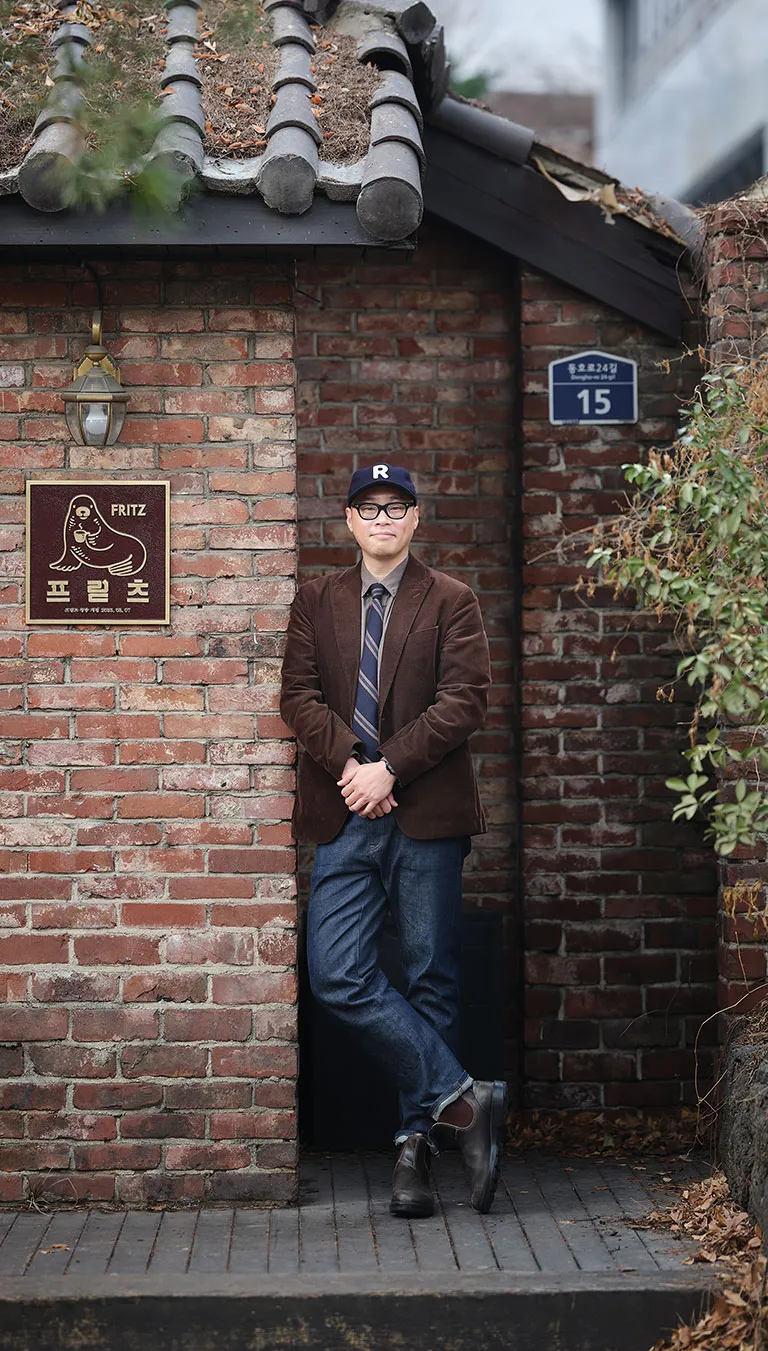
Kim Byung-ki
CEO of Fritz Company
Cover Story 2
Writer
Sung Ji Yeon
Twelve years ago, when the concept of “branding” was still unfamiliar in Korea’s coffee scene, Fritz Company stood out with a clearer sense of identity and sensibility than any other brand. Its coffee is crafted using advanced techniques and served in spaces and products that reflect a distinctly Korean sensibility. Rooted in strong values that respect coffee origins and producers, Fritz Company also fosters harmony between staff and customers. These elements have built a powerful brand and a loyal following.
Q.
What was your goal when you first established the brand?
Q.
Fritz’s visual branding, the so-called “Korean vintage,” is also mentioned as something that made this goal possible.
I incorporated Korean elements that I love, such as folk paintings, Hangeul (Korean alphabet) and old spaces. I believed that by translating the warmth and familiarity of these elements into the space and atmosphere, high-end specialty coffee could be embraced more naturally.
Elements with no direct connection to coffee—such as the seal-style logo or the deliberate addition of the ㄷ consonant to the name “Fritz” (Editor’s Note: while the standard Korean transcription would be “프릿츠,” the brand intentionally uses “프릳츠”)—were used to spark curiosity. Once that curiosity draws people into the space, it becomes easier to communicate the coffee’s taste and quality.
Q.
You’ve emphasized the importance of internal branding over design.
Design is best described as a vessel. Although Fritz operates as a small enterprise, it possesses a distinct ideology: it is a community comprised of highly motivated individuals, essentially a group of skilled craftspeople. My focus is to establish a framework where those interested in personal and professional development can collaborate in a stable environment, advance through their expertise, and achieve fulfillment.
This perspective is communicated to consumers transparently via social networking services and additional platforms. For instance, I strive to clearly and professionally convey our approach to coffee and community, including demonstrating the direct trade process with coffee producers.
Q.
You’ve been credited with starting café branding in Korea. How would you define it?
At first, I didn’t know the concept of branding itself. Looking back, everything I’d been doing was branding. I started with the desire to work with six experts in bread and coffee, but as time passed, I felt the need for strategy. I began to think about what was needed in the short term and what should be prepared for the long term.
So I approached it with the sense of building a company, not just a place that makes and sells coffee. I believed that our organization’s values would naturally become apparent. Wanting to be loved on my own terms became a method of survival, and in the end, branding served as a means to achieve that. I am convinced that this tool for survival was developed through transparently communicating my identity, preferences and the values I uphold.
Q.
Given the dynamic nature of food service trends, have there been any changes that you were required to adopt?
I don’t necessarily try to follow trends. However, I do try to distinguish whether something is a flow that continuously changes lifestyles or a temporary fad. Just as COVID-19 changed how we view time at home, lasting shifts keep shaping our lives. Meanwhile, item trends are temporary and can fade quickly.
Q.
What direction do you envision for Korean coffee and café culture?
When it comes to coffee, I wish for a culture where people can savor different flavors whenever and wherever they please. Korea stands out for its exceptional cup quality—arguably among the world’s best on average. Building on this, I hope a more open and varied coffee culture will thrive.
Furthermore, I hope café culture won’t be limited to just coffee. Since cafés are spaces where people gather, I hope they become places where people can comfortably enjoy what they want beyond coffee.
Q.
Do you think Fritz’s identity as “Korean vintage” is competitive internationally?
Korean elements with the name “K” attached are attracting attention, but separately from that, people enjoy bread and coffee. By ensuring we meet core café standards, Korean features can set our brand apart. Although we get offers to expand abroad, I prefer to wait until the team is fully ready.

Check out Fritz Company, which stands out for its solid branding.
How Korean Coffee
Crosses Borders
Lim Jung-hwan
CEO of aery coffee

Cover Story 2
Writer
Sung Ji Yeon
Where does the Korean coffee scene’s strength come from? Barista Lim Jung-hwan, who won the 2024 Korea National Barista Championship and placed fifth at the World Barista Championship the same year, knows the answer. It’s the skills and abilities of the baristas who create coffee, and the attitude they bring to it. This hard-won expertise has already been proven on the world stage.
Q.
What led you to start with coffee?
During my student years, I went through a phase where I lacked interest in academics. After watching the popular drama “Coffee Prince,” I became intrigued by the barista profession. Although it seemed appealing on screen, I suspected the real-life experience would be different, so I wanted to explore it myself. My curiosity grew stronger when I tasted specialty coffee near my home, which led me into the world of coffee.
Just as I anticipated, working in the field was nothing like being in a drama. The atmosphere was intense, yet whenever I made coffee, I felt calm inside. That’s why I came to love both coffee and this work—trying out roles as a barista, roaster and even representing my country. My journey continues to this day.
Q.
Compared with the past, what has changed most significantly in today’s coffee market or café environment?
Specialty coffee is now widely accepted by the general public and is no longer considered difficult or unfamiliar. It has naturally integrated into daily culture. Whereas extensive explanations were once necessary, rapid market growth has resulted in an increasing number of consumers who possess knowledge comparable to that of baristas.
Q.
Based on your experience in both Korean and international contexts, what distinctive features do you observe within the Korean coffee industry?
A key trait of Korean baristas is their thoughtful, persistent approach to everything they do. Their intense focus and dedication during competitions are widely recognized.
Among baristas who participate in competitions, it is often remarked that “winning in Korea is more challenging than reaching the world finals.” This reflects the exceptionally high standards and level of skill demonstrated by Korean baristas during competitive events.
In particular, these competitions require participants to develop a cohesive narrative encompassing introduction, development, transition and conclusion, centered around a single theme. The process involves persuading and engaging judges through their beverage presentations. Korean baristas consistently excel at crafting this narrative, showcasing their proficiency in both preparation and execution.
Q.
With the market and the international scene evolving quickly, do you have a personal coffee philosophy that remains constant?
For me, it’s about understanding what core values should never change and holding onto them. I’m committed to upholding high quality, which is a standard all coffee brands should meet, and I believe that a barista’s essence is found in serving a perfectly crafted cup of coffee to the customer. That’s why I always strive to approach my work with kindness and sincerity.
Q.
As a leading figure in Korea’s coffee scene, what direction do you envision for Korean coffee culture?
Korean coffee culture has already reached a level where it can stand proudly on the global stage. The reason so many establishments excel is rooted in the fact that they’ve had to strive for excellence to survive in such a competitive market. Looking ahead, I hope to see more Korean coffee brands take on the global market, not just compete domestically. Aery is also actively preparing for international expansion as part of this trend.
Q.
What is the future direction of the aery team, and do you have any longstanding personal goals?
Throughout an extended period of uncertainty, coffee became a source of comfort for me. I am now committed to sharing that experience with others.
The team’s mission is to establish itself as a global roastery and café. Through our passion for coffee, we aim to share a sense of vitality and fulfillment. Looking ahead, we plan to expand our operations to a neighboring country by approximately 2030.

Explore aery coffee, a brand admired by both Korean and global consumers.