
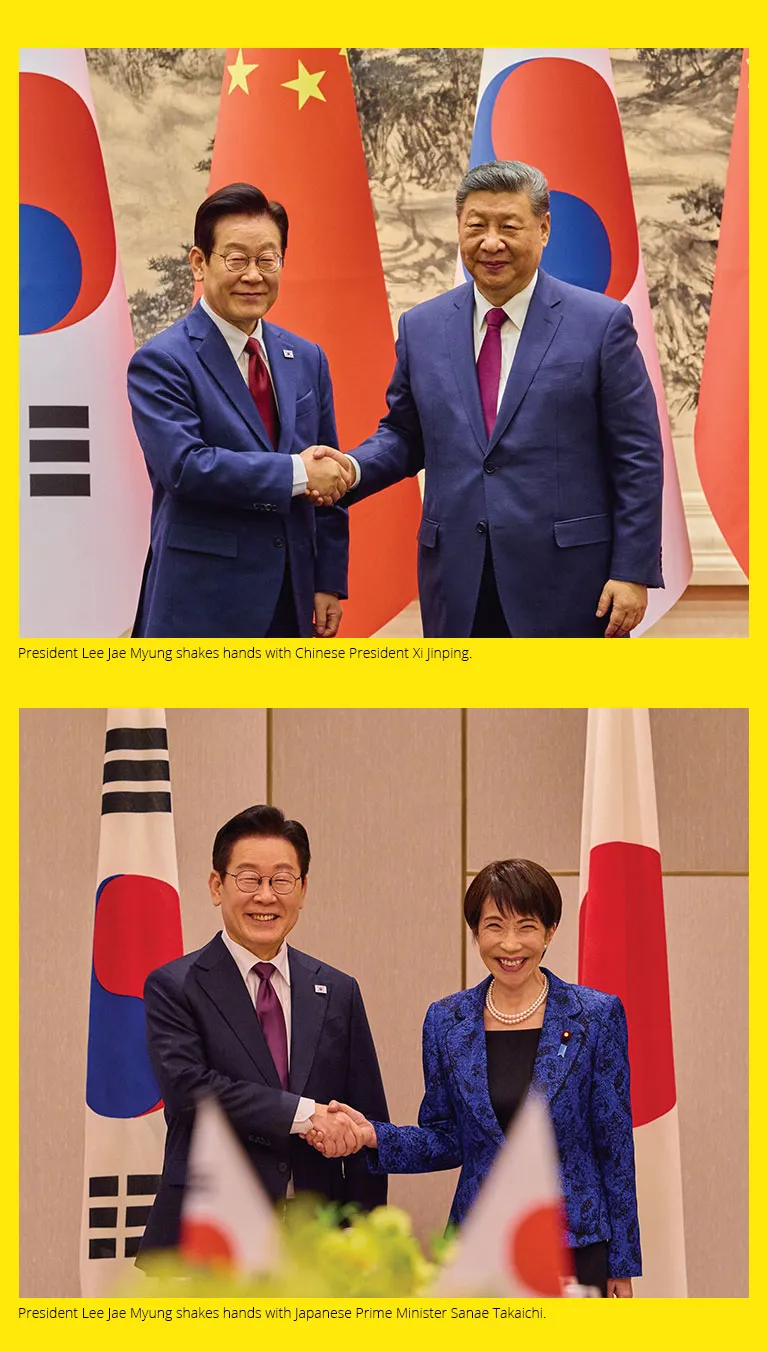
President Lee’s visit to China lasted from Jan. 4 to Jan. 7. He met with Chinese President Xi Jinping on Jan. 5 for an in-depth discussion of regional security issues, including issues affecting the Korean Peninsula, and ways to increase bilateral cooperation.
The president said his meeting with Xi was an opportunity to restore Korea-China relations and emphasized efforts by both countries to develop their strategic cooperative partnership.
“We will continue mutually beneficial cooperation in areas directly connected with people’s everyday lives and redouble efforts to address livelihood issues. Together, we will seek practical ways of achieving peace on the Korean Peninsula,” Lee went on to say.
In their meeting, the two leaders agreed to continue concrete deliberations with the goal of expanding cultural and media exchange in stages, beginning with mutually acceptable areas.
Furthermore, Lee and Xi agreed to turn the Yellow Sea into waters of peace and mutual prosperity for the steady and long-term development of Korea-China relations. They also agreed to continue constructive talks about the issue of Chinese-built structures in the Yellow Sea.
From Jan. 13 to Jan. 14, Lee visited the Japanese prefecture of Nara for a meeting with Japanese Prime Minister Sanae Takaichi to discuss cooperation for the next 60 years of Korea-Japan relations.
The two leaders promised to achieve meaningful results through cooperation on national security, technology and a range of social issues, including artificial intelligence (AI), intellectual property, low birth rates and societal aging, balanced regional growth, agriculture and disaster prevention. They also agreed to strengthen joint responses to scams and other transnational crimes.
Furthermore, Korea and Japan agreed to use DNA testing to identify the remains of victims of a tragic accident at the Chosei coal mine in 1942 in which 183 Koreans and Japanese drowned. The remains were unearthed in August 2025.
Lee and Takaichi traded their opinions about how to increase person-to-person exchange and agreed to work closely together on pressing regional and global issues and on stability and peace in the region, including the complete denuclearization of the Korean Peninsula and policy toward North Korea.
President Lee Pays Visits
to China, Japan
Current Korea
Writer
Kim Da Un
Photos courtesy of
Cheong Wa Dae