
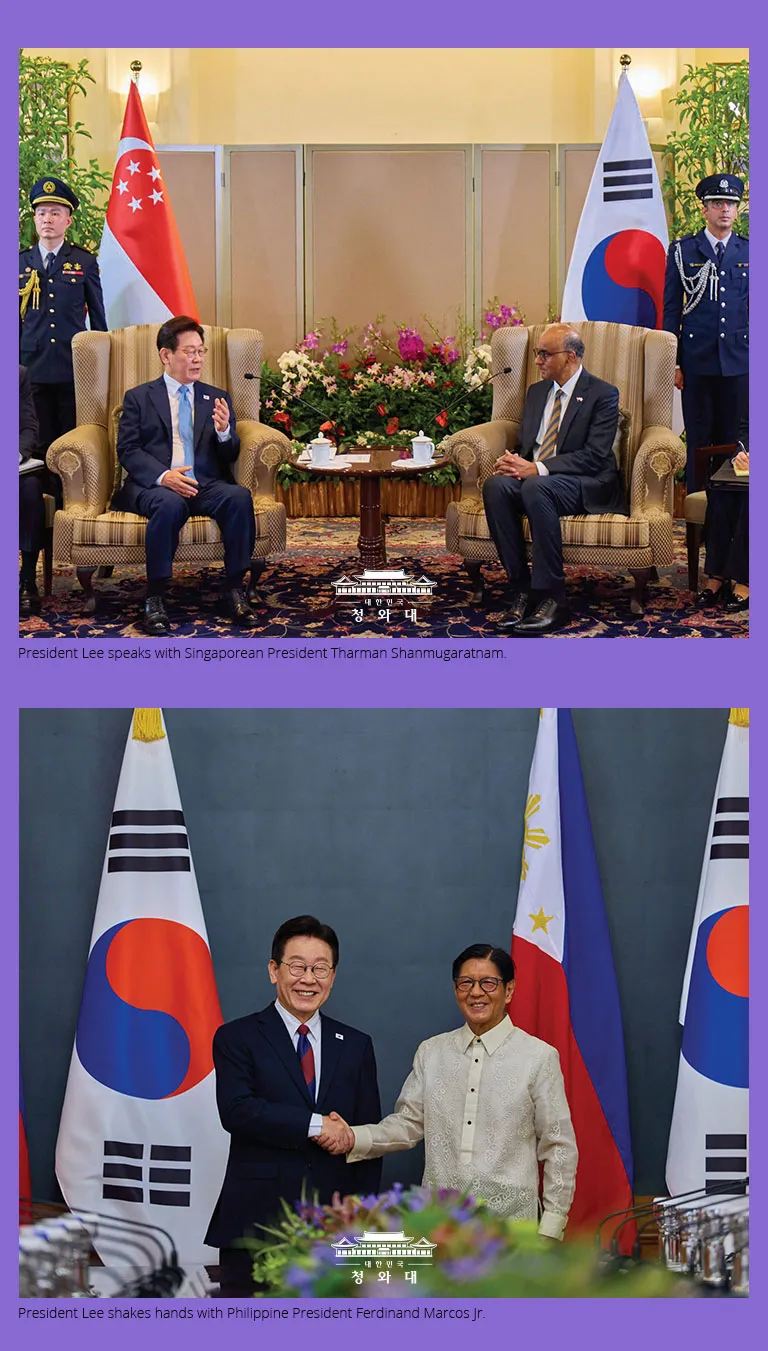
In a summit with Singaporean Prime Minister Lawrence Wong on Mar. 2, Korean President Lee Jae Myung adopted a joint statement and agreed to begin negotiations aimed at upgrading their bilateral free trade agreement, followed by a meeting with President Tharman Shanmugaratnam and a state dinner.
This was the first meeting between President Lee and Prime Minister Lawrence Wong in four months, following the APEC summit in Gyeongju last November. In their previous meeting, they had established a strategic partnership and created a roadmap for cooperation going forward.
The two leaders agreed to update the Korea–Singapore Free Trade Agreement (KSFTA) for the new trade environment. This update will include increased cooperation in four areas: supply chains, green economy, streamlined trade and aviation maintenance, repair and overhaul.
Korea and Singapore also concluded five MOUs including in those in the fields of AI and small modular reactors (SMRs). The two countries pledged to strengthen AI cooperation in autonomous robotics and real-world AI applications.
On Mar. 3, Lee held a summit with Philippine President Ferdinand Marcos Jr. in Manila. The two leaders signed a total of 10 MOUs while discussing meaningful cooperation in strategic industries of the future including the defense industry, shipbuilding and nuclear energy.
The Korean and Philippine governments took the summit as an opportunity to revise a bilateral arrangement about sourcing materials for the defense industry. Maintenance and repairs of weapon systems and logistics support were added to the arrangement, expanding the scope of cooperation between the two countries.
Nuclear energy was another area where the two countries are seeking more cooperation. They agreed to explore specific ways to expand cooperation in training workers in the area of nuclear energy as part of an MOU after the Philippines formalized plans to acquire a nuclear power plant in 2032.
Under an MOU reached regarding shipbuilding, HD Hyundai Heavy Industries will increase the supply of workers and train more skilled workers on the ground while cooperating in technological development in the industry.
President Lee Jae Myung Visits
Singapore and the Philippines
Current Korea
Writer
Kim Da Un
Photos courtesy of
Cheong Wa Dae