
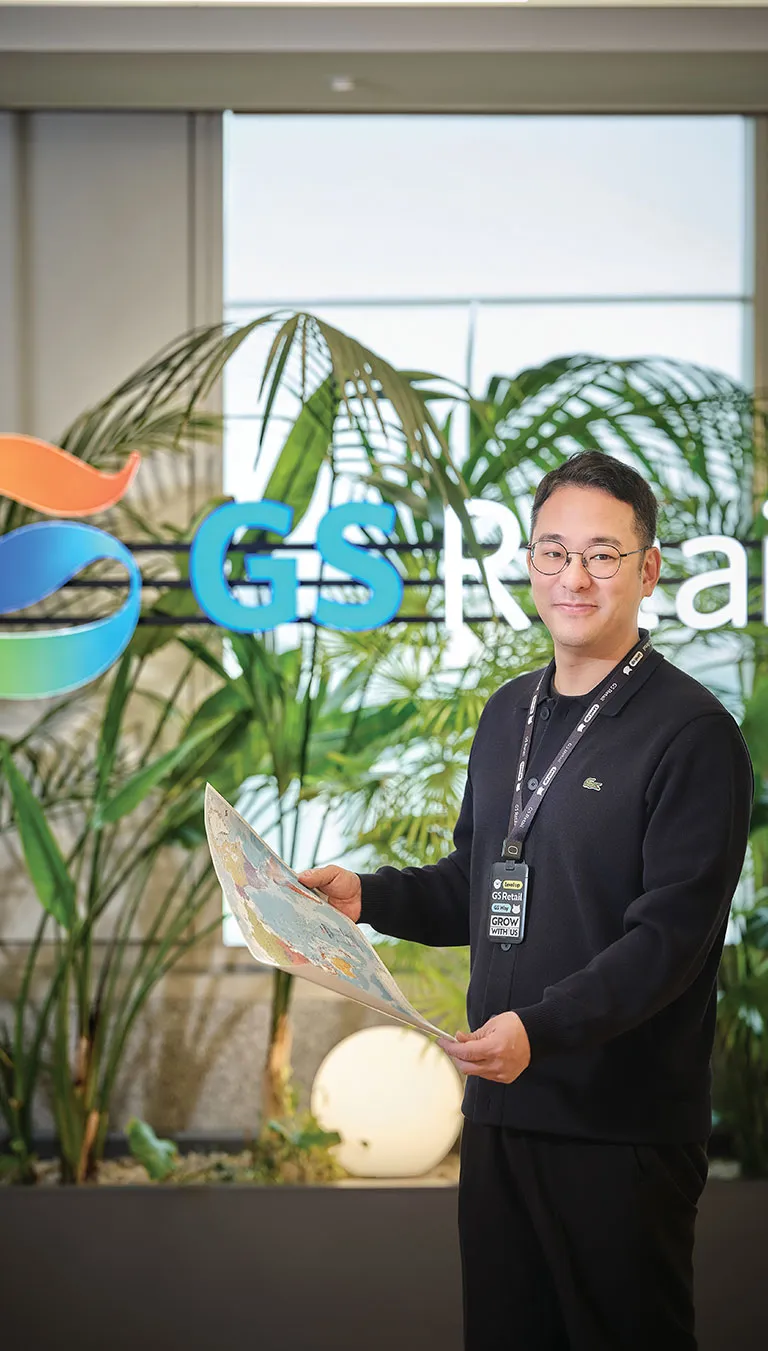
As global interest in Korean content and food continued to grow, we recognized that the Korean convenience store model could expand into something broader—a vehicle for cultural experience.
A Platform for Korean Culture,
Going Global
Chae Oh-jeong
Head of Global Business Team, GS Retail Co., Ltd.
Cover Story 2
Writer
Sung Ji Yeon
Imagine being able to experience the Korean culture you’ve seen on TV dramas and YouTube—right around the corner from your home. One company is turning that vision into reality. As of 2026, GS25 has surpassed 700 locations worldwide outside of Korea. But these overseas stores are more than just retail outlets. They’ve become spaces where customers can sample Korean products, enjoy Korean food, and naturally immerse themselves in Korean cultural life. While browsing the shelves or sitting down for a meal, shoppers find themselves inside a small hub of the Korean Wave—embedded in their own neighborhood.
Q.
What prompted GS25 to expand overseas?
Q.
What is GS25’s strategy for overseas expansion?
At the core of the convenience store business in any international market is the store network. The strategy is to build brand awareness through that network, expand customer touchpoints, and naturally establish a presence in the daily lives of local consumers. Stable store operations that deliver a meaningful brand experience are the foundation of everything we do.
Alongside this, we’re actively expanding the reach of our existing private-label products. By introducing our proven in-house products and Korean food offerings to international markets—including countries where GS25 does not yet operate stores—we’re carving out a competitive edge that’s distinctly GS25.
Ultimately, expanding the store network and building a differentiated product lineup are two complementary strategies that reinforce each other.
Q.
Do you adapt your strategy to local cultures?
Our approach to localization is this: maintain the operational DNA and product planning philosophy proven in Korea, while adjusting to fit the lifestyles and cultures of local consumers.
In Vietnam, for example, motorbikes are a fact of daily life, so store design has had to account for accessibility and parking. We’ve also reinterpreted traditional local foods as convenience store products, making the offering more approachable for Vietnamese customers.
Store layout has evolved accordingly as well. Commercial buildings in Vietnam frequently involve whole-floor leases, which tend to leave extra space—so we’ve converted that into generous lounge areas.
The result is that our Vietnamese stores have naturally taken shape as a form of convenience retail that fits local life.
Q.
What factors have been most helpful in designing your localization strategy?
A partner’s business capabilities, operational experience in the market and genuine commitment to the venture matter greatly in executing our strategy. After all, every country has its own regulatory environment, real estate market, distribution infrastructure and consumer behavior, which places real limits on what we can accomplish without strong local partners. That’s why GS25 provides the brand and the know-how, while local partners handle on-the-ground operations.
Q.
How do local strategies actually take shape?
Most ideas start on the floor. Customer flow, dwell time and purchase patterns tell you a lot just by observation: which sections people linger in, which products make them pause, what combinations they buy and at what time of day. All of this comes through in the data. From there, we run small tests. These tests involve piloting an idea in one or two stores, watching how customers respond, and if it works, scaling it gradually.
Q.
Compared to convenience store chains in other countries, what advantages do Korean convenience stores have?
First, product planning. Korean convenience stores aren’t just places that sell things—they function as platforms for creating new products and setting trends.
Second, the strength of their ready-to-eat and fresh food offerings. The experience of being able to grab a satisfying meal at a convenience store is a genuine point of differentiation.
Third, operational precision. The finely tuned systems behind promotions, inventory management and merchandising strategy are strengths that hold up in international markets—and they represent some of what sets GS25 apart globally.
Q.
How would you like GS25 to be perceived by people overseas?
The goal is to become a convenience store name that customers recognize across many countries—one they’d walk into with confidence based on the brand alone.

Take a look at how GS25 is reaching the world.
In Pursuit of
the Ultimate Dessert
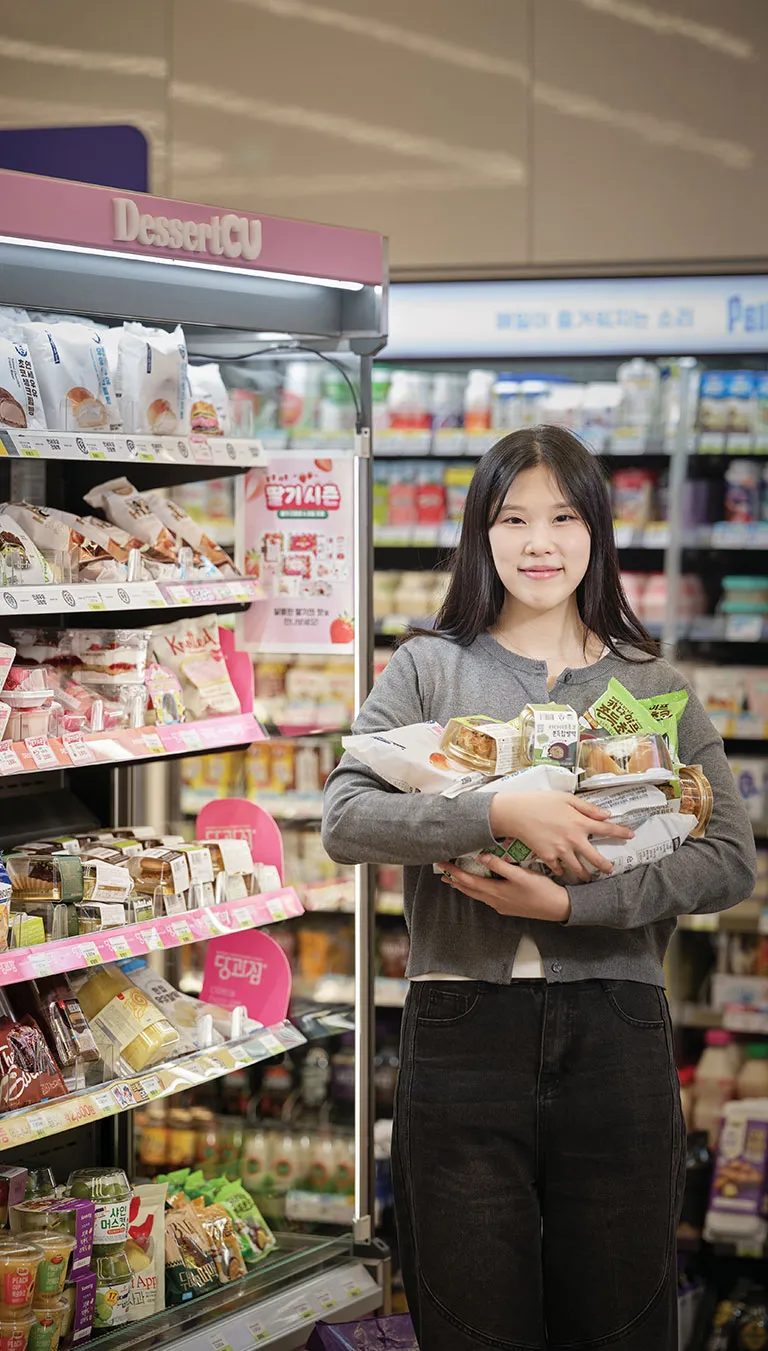
Kwon Yujin
Merchandiser, Snack Foods Team, BGF Retail
Cover Story 2
Writer
Sung Ji Yeon
Where do Korean dessert trends come from? High-end cafés? Department store bakeries? Independent patisseries? The answer might surprise you: convenience stores. They respond to trends faster than almost anyone, offering a remarkable variety of desserts at accessible prices. Among them, CU—operated by BGF Retail—has established itself as a brand that doesn’t just follow dessert trends but creates them. Kwon Yujin, the merchandiser (MD) behind CU’s dessert lineup, is driven by a vision that goes beyond a simple sweet bite: she wants every product to leave customers with a genuinely enjoyable experience.
Q.
Tell us about your role.
I oversee the full lifecycle of CU’s dessert products—from concept and development through launch and sales management. Recently I’ve been focused on the Dubai-themed series, which generated significant buzz in the Korean dessert market.
Q.
What drew you to the convenience store industry?
Trends move so much faster here than in traditional retail channels, and there's a lot of room to experiment. In convenience stores, a small idea can become a real product quickly—and you get immediate feedback from customers across thousands of locations nationwide. That combination of speed and creative freedom is what drew me in.
Q.
Walk us through the development of a standout recent product.
The Dubai-themed series has really become a signature for CU. It launched in October 2025 with the Dubai Chewy Rice Cake, and by March 2026 we’d released about 16 products in the line—with strong sales results to show for it.
The series came out of watching a dessert trend gain momentum. A first wave of chewy marshmallow cookies had already gone viral, and within that, a specific variety—a chewy cookie made with pistachios and kadayif—was spreading rapidly through independent cafés and online shops. The moment I saw where that trend was headed, I was convinced it could translate into a compelling convenience store product, and we moved fast to be the first in the industry to bring it to market.
Another example is the Yogurt Biscuit Cheesecake. A recipe was going viral on social media—mostly overseas—where you layer biscuits into yogurt, refrigerate it overnight, and end up with something that has an almost cake-like texture. We noticed that the buzz around the recipe was actually driving up sales of a particular biscuit product. So we thought: why not create a ready-to-eat version that gives people that same experience without any of the effort? That became our Yogurt Biscuit Cake.
For both products, the key question was: what’s the fun factor? Does eating it feel like an event in itself? I want customers to enjoy the discovery just as much as the taste.
CU has built a strong infrastructure for rapid product development, supported by partners, streamlined workflows and a culture that backs bold decisions—making it possible to bring products like these to market quickly.
Q.
What’s your personal approach to product differentiation?
I always come back to one question: Is this something customers have never seen in a convenience store before? Today’s consumers are highly attuned to novelty—a product with a surprise or fun angle will outperform one that's merely delicious. So I constantly look to department store bakeries, cafés and international dessert trends, and consider how those ideas can be reinterpreted for the convenience store context.
Q.
Do you have a philosophy as an MD?
Above everything else, speed. There’s a sign in one of our meeting rooms at BGF Retail headquarters that reads: “If I don't do it today, someone else will do it tomorrow.” In this industry, an idea is only as valuable as how fast you can execute it. The same concept, launched just a week apart, can produce dramatically different results. So when I spot a trend, my instinct is to move—not deliberate.
Q.
Have you noticed a shift in how Korean convenience stores are perceived?
Absolutely. Convenience stores have evolved from places you go to buy things into places you go to discover them. In the dessert and snack categories especially, new products spread through social media almost instantly, and people actively visit convenience stores to try them. There’s a growing sense that convenience stores are a trend platform—a place where culture is created, not just consumed.
Q.
What are your personal goals?
I want to create products that give customers something close to a specialty dessert shop experience inside a convenience store. That means nailing not just the flavor but the visual presentation and the overall concept. Ultimately, I’d love to launch something so culturally significant that people say, “That trend started at CU.”

Explore CU of BGF Retail, at the forefront of Korean food trends.