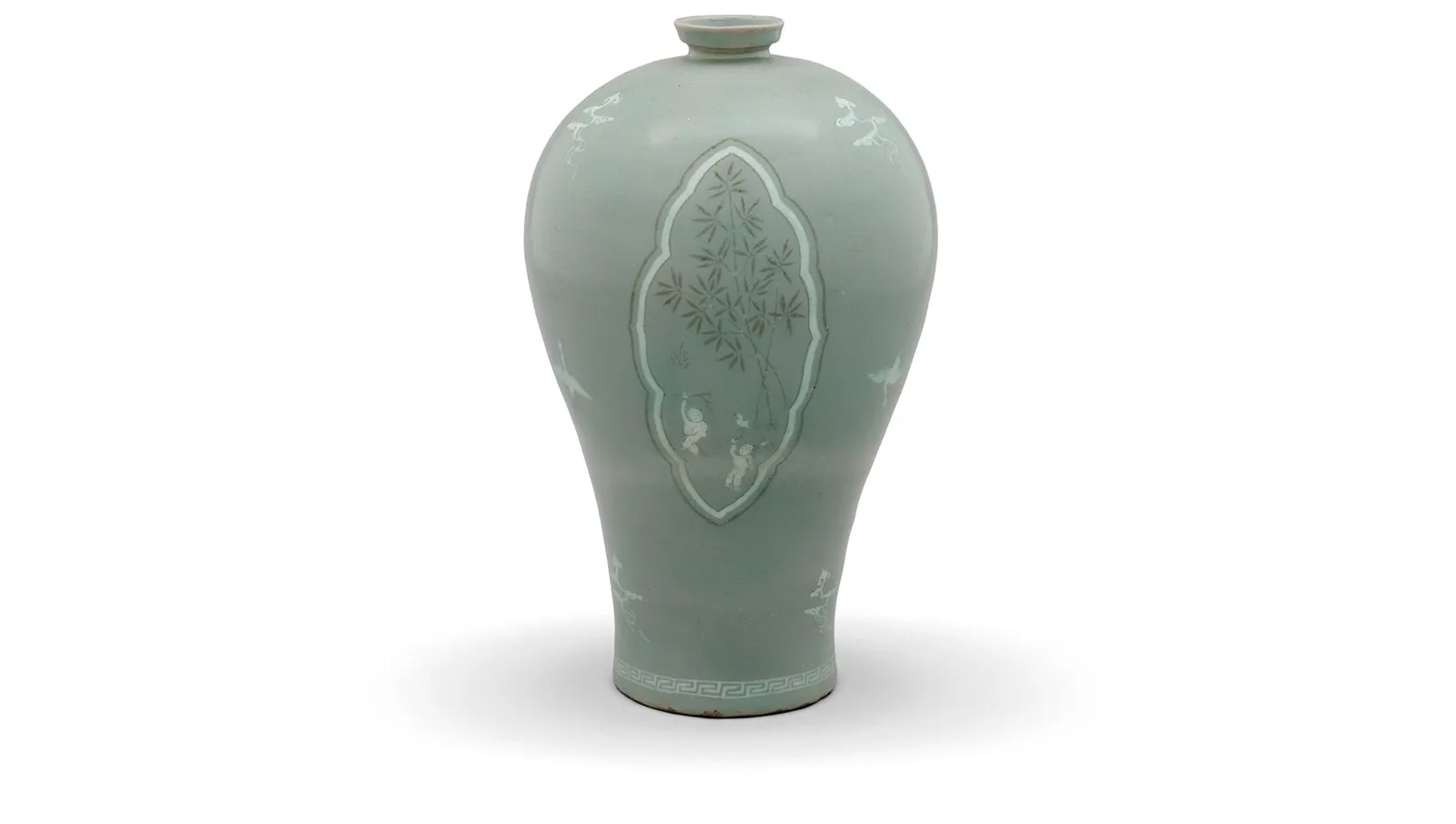

The Art Institute of Chicago in Illinois draws 1.3 million visitors each year to see treasures spanning different eras of Korean history. Among them, the elegant ceramic “Plum Vase (Maebyeong) with Clouds, Cranes and Children Motifs” tells a special story that connects Korea and the United States, beyond just its artistic value.
The “Plum Vase (Maebyeong) with Clouds, Cranes and Children Motifs” is a 33.5 cm tall jar made in the late 12th century during the Goryeo Dynasty (918–1392). Its graceful curves—a full body tapering to a narrow mouth—are striking. The subtle jade-colored glaze displays Goryeo’s distinctive aesthetic. While “celadon” generally refers to various blue-green ceramics, Goryeo artisans specifically pursued a jade-like quality. This is why celadon from other countries tends toward gray, while Goryeo celadon has that mysterious blend of green and blue.
The patterns carved into the jar are equally distinctive. In a framed scene, two children chase birds and butterflies through a garden of bamboo. Beyond the frame, cranes and clouds create a lyrical atmosphere. The two children symbolize fertility, while the bamboo represents humility—a virtue prized by scholars of the time.
The technique used is remarkable. After shaping the clay, artisans carved the surface and filled the grooves with differently colored clay. This inlay technique originally came from woodworking, but Goryeo potters adapted it to ceramics, achieving both aesthetic beauty and symbolic depth.